
Why Should I spend 5 minutes a Day on my Pelvic Health?
Paula Bruckner | JUL 12, 2023
Hi Everyone, my awesome friend Ellen let me do a guest writing spot on her blog Ask Away and I thought I would share it with you, too! Happy coughing and sneezing.
Have you ever sneezed, coughed, jumped and PEED? Just a little bit? Just enough to wonder if your pants are wet? Just enough to be wearing special underwear or a pad for it?
Well, you’re not alone! According to the Mayo Clinic, 50% of adult women are having urinary incontinence; which is the involuntary leakage of urine when they are not trying to pee. Alarmingly this number jumps up as we age, and 75% of women over 65 report urinary incontinence.
Why is this happening and what can we do to stop it?
First things first, let’s have a conversation about it. It’s normal. It’s something our bodies do. It’s nothing to be ashamed of or sweep under the rug. Ask your doctor, ask your friend, ask your mom. The more we can normalize women’s health issues, the more support and good information we can get for ourselves. So, here’s some good information from a pelvic health professional:
Believe it or not, most urinary incontinence is due to a tight pelvic floor. The pelvic floor is made up of 26 different muscles and is fairly small compared to its helper muscles, the glutes, inner things, and lower belly. When the pelvic floor is too tight and the helper muscles aren’t doing their job to support it, the pelvic floor can often allow leakage or peeing when you don’t want to. Imagine the pelvic floor, and it’s so tight, it’s already carrying a brick around all day, a heavy load and working super hard to hold on. When that cough or sneeze comes along, it’s like dropping a 2nd brick onto the first, and what happens if the muscle is already fatigued from carrying the first brick? Yep, it drops both bricks and some pee comes out!
This is NOTHING to be ashamed about, remember 50% of women have this, too. But what, you may ask, can I do about it? If you’re really suffering, I suggest seeing a specialist, like a pelvic floor physical therapist or anyone trained as a Pregnancy and Postpartum Corrective Exercise Specialist or PCES. If you want to try to give it a go at home, take 5 minutes out of your day and try these simple but effective moves. Dedicate 2.5 minutes when you wake and before you go to sleep, it’s just like brushing your teeth.
Follow these 4 exercises pictured below:


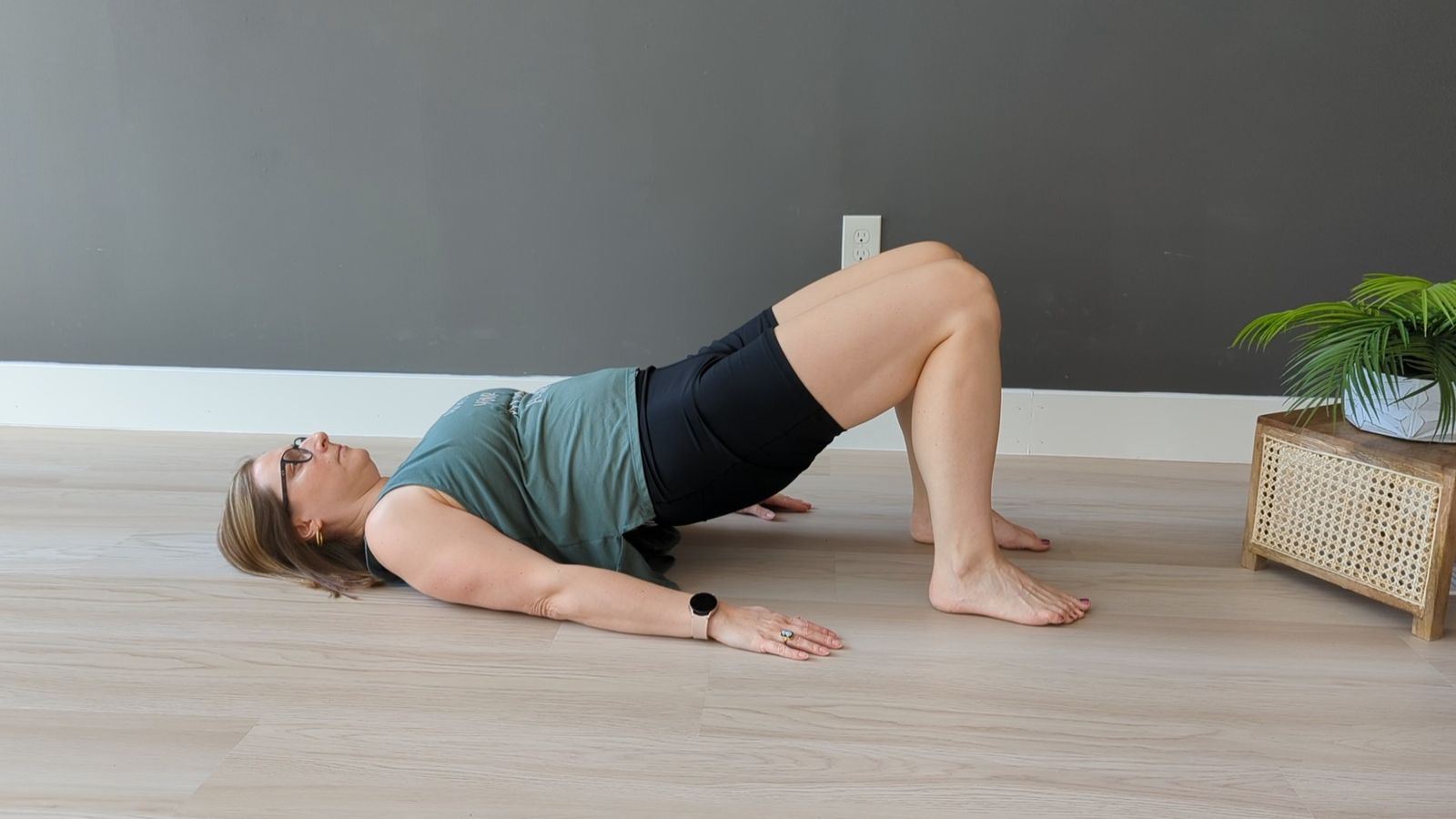
Stick to this routine twice a day and see if you still need to cross your legs before you sneeze after 30 days.
Some pro tips:
- Stop doing Kegels! They can make a tight pelvic floor even tighter. If you still want to work on contracting your muscles, sit on an exercise ball, or Swiss ball, and rotate your hips in a circle, one direction and then the other. This contracts AND lengthens all the pelvic floor muscles.
- Stop peeing just in case! This trains the bladder to empty early.
- Identify bladder irritants and try to cut them out- tomatoes, alcohol, caffeine, coffee—I know it’s not fun, but neither is peeing yourself.
- Stop Smoking
- Relax whenever you can and practice breathing. A good method is breathe in for 4, hold for 7 and exhale for 8 seconds.
May your coffee and your pelvic floor be strong today,
-Paula
Paula Bruckner | JUL 12, 2023
Share this blog post
